Planet X Trivia: How Much Do You Actually Know About the “Hidden Planet”?
“Planet X” is one of those phrases that sounds like a movie title. It’s mysterious, ominous, and just scientific enough to feel plausible. But here’s the twist: Planet X is both real science history and a pop-culture magnet, depending on who’s using the term.
In astronomy, “Planet X” originally meant “some unknown thing that might be affecting orbits.” Today, the modern version of that idea is usually called Planet Nine. Online, though, “Planet X” often gets mashed into Nibiru and other doomsday myths. That’s not a small misunderstanding—it’s basically how the “hidden planet” trope stays alive: one legitimate mystery plus a lot of narrative wishful thinking.
Crack open more surprising stories from the world of Planet X!
What Is Planet X and Why Is It Hidden?
What lurks in the darkest corners of our solar system, exerting gravitational influence yet evading our most powerful telescopes? You're searching for Planet X—a theoretical Neptune-sized world traveling an extremely elongated orbit 20 to 30 times farther from the Sun than Neptune. This hypothetical ice giant would take 10,000 to 20,000 years to complete one revolution.
The detection challenges of distant objects like Planet X stem from their extreme remoteness. You'd need a body significantly larger than Uranus or Neptune to spot it at such distances. Current sky surveys haven't detected this member of the undiscovered celestial bodies category. Instead, astronomers rely on indirect evidence: gravitational perturbations affecting trans-Neptunian objects in the Kuiper Belt.
Yet some researchers argue these patterns result from random distribution, not planetary influence. The theory gained renewed attention when Caltech astronomers Brown and Batygin analyzed the orbital clustering patterns of distant objects like Sedna, concluding that Planet X's gravity best explains these celestial alignments.
Why is it “hidden” if it’s supposedly big?
Because distance is everything. Objects hundreds of AU away (AU = Earth–Sun distance) receive very little sunlight, meaning they reflect very little light back to us. That makes even a large object extremely faint—especially if it’s currently near the farthest part of its orbit. That’s why researchers lean so hard on indirect evidence (orbital patterns) before claiming direct detection.
There’s also an unfair advantage the sky has over us: it’s enormous. Even with modern surveys, you’re searching a huge 3D space where the object could plausibly be, and you have to separate a slow-moving speck from a background of stars.
Tilted Orbits and Clustering: The Evidence for Planet X
Beyond Neptune's orbit, six of the most distant known objects in our solar system share a peculiar secret: their orbits align in a single direction with odds of just 0.007% that this arrangement happened by chance.
You'll find these extreme trans-Neptunian objects tilting nearly identically—approximately 30 degrees downward from the ecliptic plane. Their long period orbit dynamics can't be explained by randomness alone, requiring a massive gravitational shepherd. What's more intriguing, Kuiper Belt objects between 50-80 AU display an eight-degree tilt, while correlations exist among 28 extreme objects and 24 Centaurs.
Unlike asteroid belt disturbances caused by Jupiter, these patterns demand something bigger—possibly a planet with semi-major axes between 400-1500 AU. Alternative explanations, including the Milky Way's tidal influence, simply don't account for this clustering.
How Big Is Planet X and What's It Made Of?
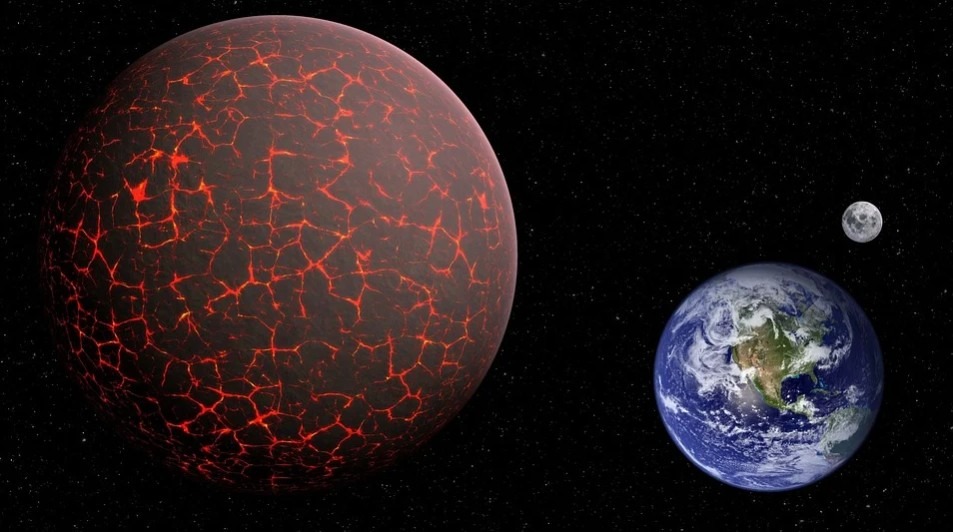
Zeroing in on Planet X's physical characteristics presents researchers with a fascinating puzzle, since no one has actually observed this hypothetical world directly. You're looking at estimates suggesting it's approximately 1.5 times Earth's size, with mass ranging between 5-10 times our planet's magnitude.
This composition speculation places it in Neptune-sized territory, potentially featuring potential ice characteristics similar to Uranus or Neptune's internal structure. The object's presumed rocky core might be surrounded by icy materials, given its Kuiper Belt positioning.
Detection remains extraordinarily challenging—it's hundreds of times fainter than Pluto and receives minimal solar light at distances 300-800 times Earth's orbital radius. If Planet X exists, its 20,000-year orbit would make it incredibly slow-moving across the sky. Alternative theories even propose it could be a primordial black hole, explaining both gravitational anomalies and telescopic non-detection.
When Will We Finally Spot Planet X?
Knowing where to search means little without the capability to actually find this distant world. Search timelines suggest you'll have answers within the next decade. Current surveys have already excluded 56% of previously possible orbits, and the remaining parameter space should be fully probed by the mid-2030s. However, observational limitations remain challenging—Planet X's extreme distance makes detection difficult even with advanced instruments.
The path forward includes:
- Infrared surveys showing the most promise, as Planet X appears 100 times brighter in infrared than visible light
- Extremely Large Telescopes launching by 2027 with unprecedented sensitivity
- Machine learning algorithms systematically analyzing archival data
- Consecutive-night parallax methods eliminating remaining orbital possibilities
You're approaching either confirmation or definitive non-detection rather than continued uncertainty. Distinguishing genuine orbital clustering from survey bias will require observing approximately 100 ETNO orbits to reach statistical confidence.
How the Search for Planet X Started and Evolved
The search for distant planets began not with sophisticated technology, but with mathematical detective work. When Uranus showed peculiar orbital motion in the early 1800s, Urbain Le Verrier calculated where an unknown planet should be—and Neptune was discovered exactly there in 1846.
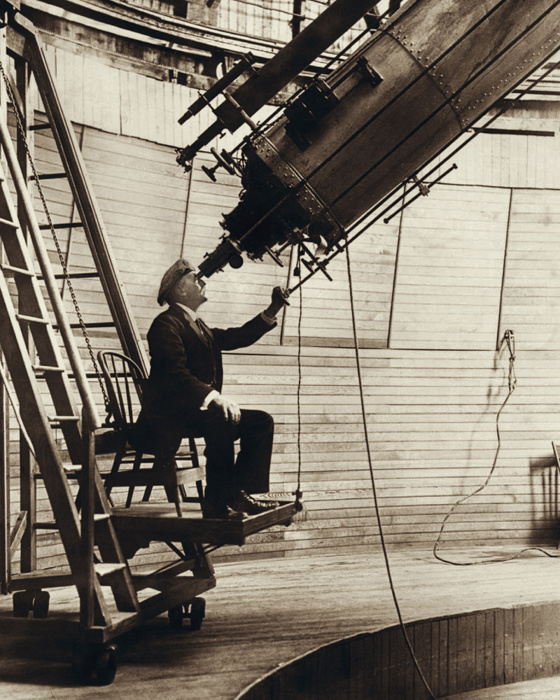
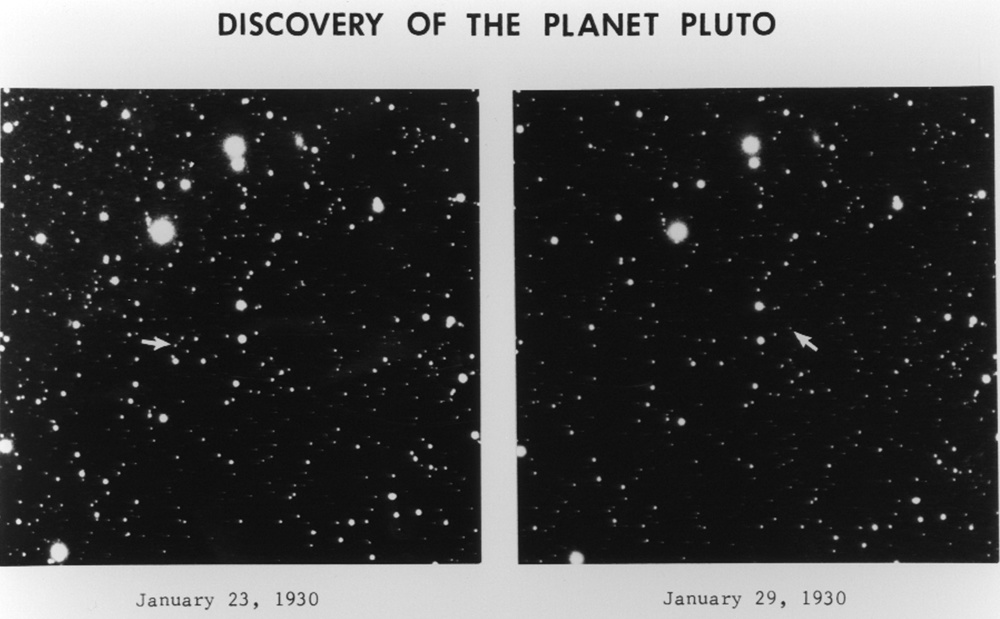
This success inspired Percival Lowell to seek "Planet X" starting in 1906, employing evolving observational techniques like photographic plates and the blink comparator. After Lowell's death halted progress, Clyde Tombaugh resumed the search in 1928, discovering Pluto in 1930. However, Pluto proved too small to perturb Neptune's orbit. Later analysis revealed the supposed orbital irregularities were simply measurement errors, demonstrating how technological advancement eventually corrected earlier assumptions.
Planet X vs. Planet Nine: What's the Difference?
While both terms refer to hypothetical planets lurking in the outer Solar System, Planet X and Planet Nine represent fundamentally different concepts separated by a century of astronomical discovery. Planet X served as a mathematical placeholder—an algebraic variable representing whatever might explain Neptune's orbital irregularities. When planet x discoveries like Pluto proved too small, astronomers continued searching without defined parameters.
Planet Nine, proposed in 2016, presents specific characteristics:
- Mass: Approximately 10 times Earth's mass
- Orbit: 20 times farther than Neptune, requiring 10,000-20,000 years per revolution
- Purpose: Explains Kuiper Belt object clustering
- Detection method: Advanced telescopes and supernova light detectors
Could Planet X Be a Black Hole Instead?
What if Planet Nine isn't a planet at all, but rather a primordial black hole lurking at the edge of our Solar System? Physicists Jakub Scholtz and James Unwin suggest this bowling ball-sized remnant from the Big Bang could explain gravitational anomalies affecting Kuiper Belt objects.
The potential gravitational effects of black holes would account for unusual orbital clustering patterns among Trans-Neptunian Objects without requiring visual detection. Harvard scientists developed methods to spot black hole flares when consuming comets, which the Vera C. Rubin Observatory will search for during its upcoming 10-year survey.
However, challenges of black hole detection methods make confirmation difficult. Alternative explanations include a conventional Neptune-sized planet, galactic gravitational influence, or random orbital distributions. The evidence remains inconclusive, requiring extensive research before determining Planet X's true nature.
The Nibiru Problem: How Real Astronomy Gets Dragged Into Doomsday Lore
The reason Planet Nine discourse gets tangled with “hidden planet” conspiracies is simple: it sounds cinematic. A secret world in the dark is the kind of idea that slides easily from scientific papers into YouTube thumbnails.
But the doomsday version (Nibiru-style claims) collapses under basic physics. A planet-sized object on an Earth-crossing path wouldn’t be “hidden.” It would be visibly bright, and we’d see major gravitational disruption in the solar system long before it got close. That’s why credible scientific discussion keeps Planet Nine far away: the data being discussed is about the outer solar system, not an incoming collision.
Why The “Hidden Planet” Trope Won’t Die
Even when the details change, the story engine stays the same: humans love the idea that there’s a secret explanation just out of view. Planet Nine gives that urge a legitimate science-shaped container—while the internet gives it infinite remix potential.
That’s why Planet X keeps “coming back.” Not because we’ve confirmed a hidden planet is coming for us, but because the concept sits perfectly at the intersection of:
- a real scientific mystery (outer solar system dynamics),
- a massive, hard-to-search space (so uncertainty lasts),
- and pop culture’s favorite genre: the uncovered secret.
Conclusion
Planet X works so well as a cultural obsession because it lives in the overlap: real science on the outskirts of our solar system, and a public imagination trained to treat “hidden” as “meaningful.” The legitimate hunt for Planet Nine is slow, statistical, and stubbornly uncinematic—but the internet can’t resist turning that patience into prophecy, or mystery into myth. Still, the most interesting version of this story isn’t a doomsday countdown. It’s the reminder that some questions actually take time, and that uncertainty isn’t a cover-up—it’s the normal state of discovery.